

Product Finder










Reading out loud with children is one of the most powerful things an adult can do for them
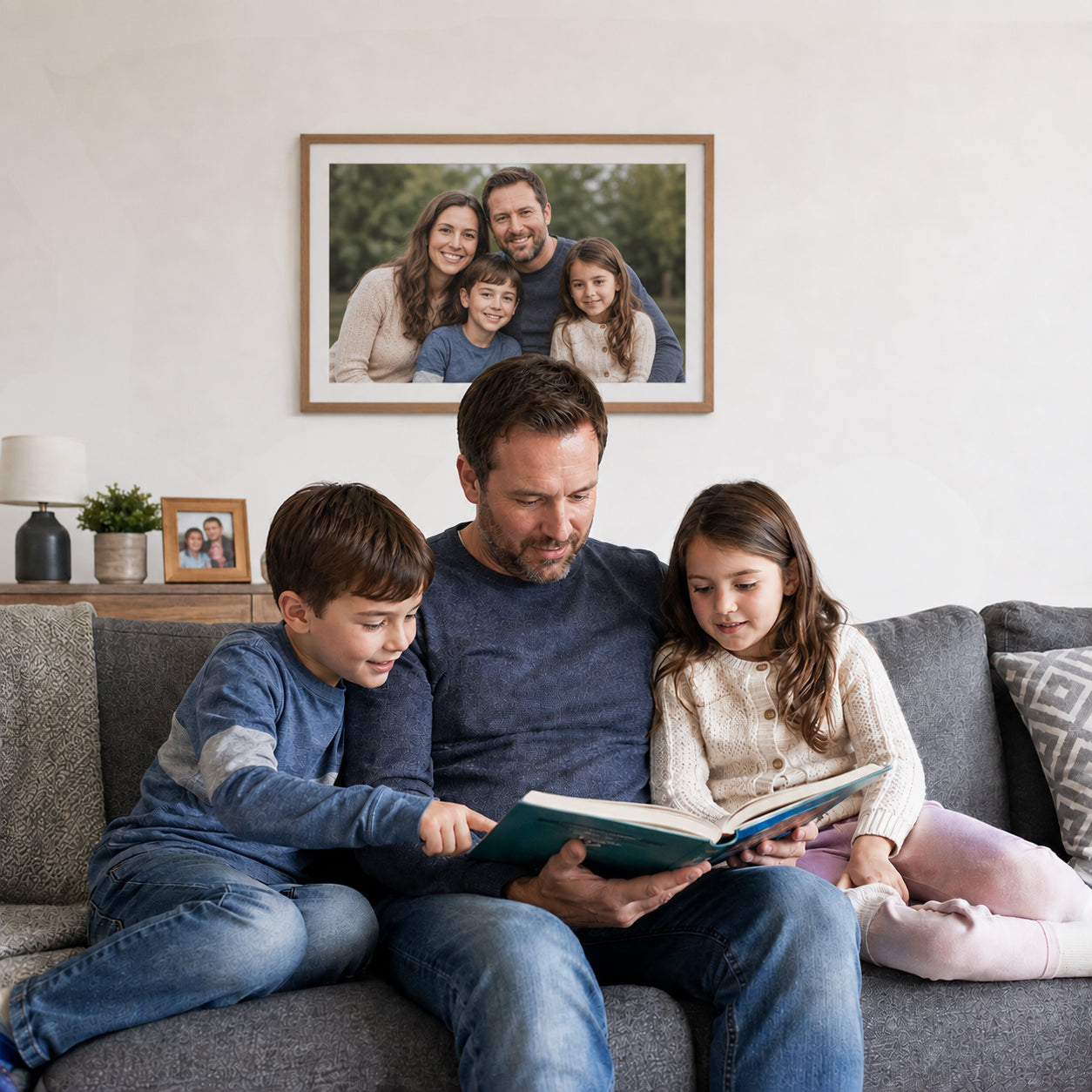

This blog is a bit of a departure from our normal content and may not be what you would expect from a fair trade retailer. I am writing this one as a father and grandfather who cares about reading and the positive effects it can have.
Reading stories with my daughters, both in person and over video call, was one of the most enjoyable aspects of being a dad and we built so many memories together as we did it. That's one of the reasons we are launching Letters From Gaius for Advent this year (2026) to promote family reading time.
Letters From Gaius will appeal mostly to our faith-based customers but, whatever your reading taste, it is surprising what a positive effect reading out loud with the children in your life can have.
Don't just take my word for it, though. The evidence is compelling.
Being a parent of school-age children is exhausting. There's the school run to do. You need to make sure they've done their homework, packed the right sports kit and picked up their packed lunch. And then there's the emotional support, the exam prep and paying for the school trips. It keeps you busy. It can be stressful. But, deep down, you know it is about giving them a future.
But, there's also the "quiet" part where you sit down with the child you love and just a read book out loud, together, for ten or fifteen minutes.
This part costs you time, rather than money or energy but, according to the evidence, it's one of the most powerful things any adult in a child's life can do.
Typically this is one of mum's jobs but there is good evidence that it doesn't need to be. It's about adults who read. Grandparents, uncles, aunties, step-parents, foster carers, childminders, the family friend who comes for tea — the benefit travels with whoever happens to be holding the book.
We've pulled together what the research actually shows below. Researchers do love their jargon, though. So, where the studies use it, we've translated it into layman's terms for you.
What the evidence actually says
1. Books are full of words that don't show up in conversation
Everyday chat with a child is vital and helps bonding, but it's a bit repetitive. Most of us cycle through the same few thousand words: dinner, shoes, careful, lovely, come on, nearly there etc.
Books don't do that. Even a simple picture book will use vocabulary like scurry, reluctant, harbour, ancient — words they'd be unlikely to bump into over breakfast.
A team at Ohio State University decided to count. They took 60 of the most commonly read children's books, worked out how many words were in each, and multiplied that by the years before a child starts school.
Their finding: a child who has one picture book read to them each day hears roughly 78,000 words a year from books alone. By the time they reach school, children from book-filled homes hear something like 1.4 million more words than children who are never read to at all.
The researchers called it the "million word gap."
Why does that matter so much? Because reading is largely a matter of recognition. When a child meets the word reluctant on a page, having heard it fifty times before at bedtime, it's like greeting an old friend. But, for a child who has not been read to, it is like having to solve a tricky puzzle.
2. You can see it happening in the brain
In 2015, researchers at Cincinnati Children's Hospital did something fascinating. They put 3- to 5-year-olds into an fMRI scanner — a machine that shows which parts of the brain are working hard at any given moment — and played them stories to listen to.
Children who were read to more at home showed noticeably more activity in the parts of the brain that handle meaning, following a story, and making mental pictures.
Hutton et al., Pediatrics, 2015In plain terms: a child who is read to is getting practice at building pictures in their head from nothing but words. That's the very skill that, in later life, will allow them to read a page and actually see it in their imagination — rather than just hearing the words.
3. The benefit doesn't wear off
Two economists in Australia followed thousands of children over several years and asked a simple question: do the benefits of being read to, as a small child, survive into later life?
They do. Children who were read to at ages four and five were doing better on reading and thinking tasks all the way up to ages ten and eleven — five or six years after the reading in question.
Researchers are professionally suspicious of results like that, so the authors ran the numbers again and again in different ways, deliberately trying to find a fault with the results. They couldn't find one.
Kalb & van Ours, Economics of Education Review, 20144. We know it's reading together that's making the difference
Families who read together a lot tend to differ in all sorts of other ways — income, education, how much spare time they have etc. So how do we know it's the reading that's making the difference?
What's a randomised controlled trial?
You take a group of families and essentially flip a coin. Half get support to read together more; half carry on as normal. Because the coin doesn't care how wealthy or bookish anyone is, any difference that shows up afterwards can be pinned on the reading itself. It's the same method used to test whether a medicine works.
Researchers gathered up 19 of these trials — covering nearly 2,600 children — and pooled the results into a single analysis.
And a meta-analysis?
Combining lots of separate studies into one. The point is that a single small study can mislead, but twenty studies all pointing the same direction rarely do.
The children whose families were supported to read more together performed better in both main language categories:
- Expressive language — the words a child can actually use. Effect size 0.41.
- Receptive language — the words a child understands when they hear them. Effect size 0.26.
What's an "effect size"?
Dowdall et al., Child Development, 2020
The researchers' way of asking "yes, but how much?" As a rough rule of thumb, 0.2 counts as a small effect, 0.5 as moderate and 0.8 as large. So 0.41 is a solid, real shift — not a life transformation, but a genuine push in the right direction, from something that costs nothing and takes ten minutes.
The study had another important finding. The families who only read together occasionally saw very little benefit from it (0.19 — barely anything). The families who read together regularly benefited more than twice as much (0.54).
Little and often beats occasional and heroic. Five minutes on a Tuesday, and again on Wednesday, is worth more than an hour of determined effort on a Sunday.
5. It's not only reading that improves
This relatively unknown finding offers a great deal of hope to parents supporting struggling children.
A project at NYU worked with low-income families from the birth of their child onwards, helping them read aloud and play together. It was another of those coin-flip trials, so the comparison is a fair one.
When the children were assessed at four and a half — a full eighteen months after the support had ended — the reading group showed fewer behavioural difficulties across the board: less aggression, less hyperactivity, better attention. Among children whose hyperactivity had been at a level a clinician would flag as significant, symptoms dropped by around 69%.
Mendelsohn et al., Pediatrics, 2018Which, when you think about it, shouldn't be that much of a surprise. Reading aloud offers a warm, close, predictable, ten-fifteen minutes with an adult who isn't looking at their phone all the time. So, of course it makes children more relaxed and peaceful.
It has a similar effect on the adults, too.
6. Meanwhile, reading for pleasure is having a hard time
The National Literacy Trust asks over 100,000 UK children every year whether they enjoy reading. In 2026 the answer improved for the first time in five years — 36.1% said yes, up from 32.7%, which had been the lowest figure in two decades.
That's genuinely good news. But it also means almost two out of every three children still don't enjoy reading in their own time,
National Literacy Trust, 2026This is where adults can make a real difference
A book read to you by someone who loves you is a completely different proposition to struggling through a book you've been made to read. It's the one version of reading that almost no child turns down.
The idea is that, by giving the child repeated, positive reading experiences, you help them build the desire and confidence to read on their own.
How to do it well
There's one technique the research keeps returning to, and it has a slightly off-putting name: dialogic reading. All it means, though, is reading as a conversation rather than a performance.
Instead of getting to the end of the page and turning it, you stop. You ask an open question — the kind that can't be answered with yes or no. Then, and this is the hard part, you wait. And you follow wherever the child takes the conversation, even if it's somewhere odd.
It sounds like:
- "What do you reckon happens next?"
- "Why's he gone all quiet, do you think?"
- "Have you ever felt like that?"
- "Which one would you rather be?"
When researchers pooled 64 studies of this approach published between 2000 and 2025, the overall benefit to children's reading was substantial — an effect size of 0.76.
Learning and Individual Differences, 2026You don't need to do it on every page. A couple of questions per session is plenty.
A few points worth making
Parents
Protect the ritual rather than the performance. Ten, reasonably enjoyable minutes, every night, beats forty brilliant ones just on a Sunday. And don't stop the moment they can read for themselves — children can understand far harder books, when they're read to them, than they can decode on their own, for years after they learn to read. So, you're still their route into stories they couldn't manage by themselves.
Grandparents
You have the two things busy parents often run short of: time, and patience. They can be your reading superpowers. Read them the books that were read to you as a child. Stop mid-page to say "we had a dog just like that" or "This is my favourite part." Let them know you are enjoying it too.
Reading together is one of the best ways to build family memories across the generations — and the evidence on learning across generations suggests it does you good too. It offers you company, purpose and a reason to be in the room. Distance doesn't have to be a problem either. If you live a long way away, try reading over Zoom or FaceTime. It works really well.
Dads, Grandads, Uncles and Male Carers
This is your call to action.
A UK study tracked how much fathers were involved and what happened at school. Among children whose fathers read to them regularly, 60% reached a good level of overall development in their reception-year assessment. Among children whose dads rarely did, it was 38%.
And yet only around a quarter of fathers (26%) read with their children daily, compared with 37% of mothers. The Fatherhood Institute's term for this is blunt: dads are "the forgotten parents" of family literacy. It's not because men don't care and it's not that mum's don't want to share the reading duties either. It's mostly due to the assumption - in both men and women - that "It's what mothers do". This paradign needs to be challenged.
When men read with their kids, the results are significant. But, if a child never sees a man read for pleasure, they learn something from that too.
Fatherhood Institute, written evidence to the UK Education Committee, 2026Foster Carers, Childminders and Kinship Carers
The attachment research is firmly on your side here. Shared reading offers children a number of things at once: close physical contact, undivided attention, and a shared emotional experience. For a child who's had a lot of disruption in their life, a familiar story at a predictable time is a small promise, made and kept, every single day. Those simple tokens of normality can have a disproportionate effect on their sense of stability
The short version
Fifteen minutes reading per day makes a huge difference. It can be any adult and almost any book. Ask a question or two rather than just reading the words. Frequency matters more than quality.
It costs nothing, it works, and it's one of the few times in a child's life when who they're doing it with matters more than what they're actually doing.
Sources
- Logan, J.A.R., Justice, L.M., Yumuş, M. & Chaparro-Moreno, L.J. (2019). When Children Are Not Read to at Home: The Million Word Gap. Journal of Developmental & Behavioral Pediatrics, 40(5), 383–386.
- Hutton, J.S. et al. (2015). Home Reading Environment and Brain Activation in Preschool Children Listening to Stories. Pediatrics, 136(3), 466–478.
- Kalb, G. & van Ours, J.C. (2014). Reading to young children: A head-start in life? Economics of Education Review, 40, 1–24.
- Dowdall, N. et al. (2020). Shared Picture Book Reading Interventions for Child Language Development: A Systematic Review and Meta-Analysis. Child Development, 91(2), e383–e399.
- Mendelsohn, A.L., Cates, C.B., Weisleder, A. et al. (2018). Reading Aloud, Play, and Social-Emotional Development. Pediatrics, 141(5), e20173393. (Open access.)
- National Literacy Trust (2026). Children and young people's reading in 2026.
- Effects and moderators of dialogic reading on children's reading literacy: A three-level meta-analysis on studies from 2000 to 2025. Learning and Individual Differences (2026).
- Fatherhood Institute (January 2026). Written evidence to the UK Parliament Education Committee, Reading for Pleasure inquiry (RFP0084) — citing Norman, H. & Davies, J. (2023), What a Difference a Dad Makes, Leeds University Business School.
- Whitehurst, G.J. et al. (1988), summarised in What Works Clearinghouse: Dialogic Reading intervention report.
- Kinship / Learning with Grandparents. Project report.
- Reach Out and Read. Reading Aloud, Play, and Social-Emotional Development — research summary.