

Product Finder










- Alara
- Asilia Salt
- Bethlehem Baubles
- Black Mamba
- Café Direct
- Cajuu Cashew Nuts
- Divine
- Equal Exchange
- Fair To Trade
- Island Bakery
- Mama Buci Zambian Honey
- Namaste
- Planet Wrap It
- Rounton Coffee Roasters/We Are Fair Trade
- Serious Tissues
- Shared Earth
- Steenbergs
- Suma Wholefoods
- Traidcraft
- We Are Fair Trade
- Zaytoun
Ethical Logos Compared
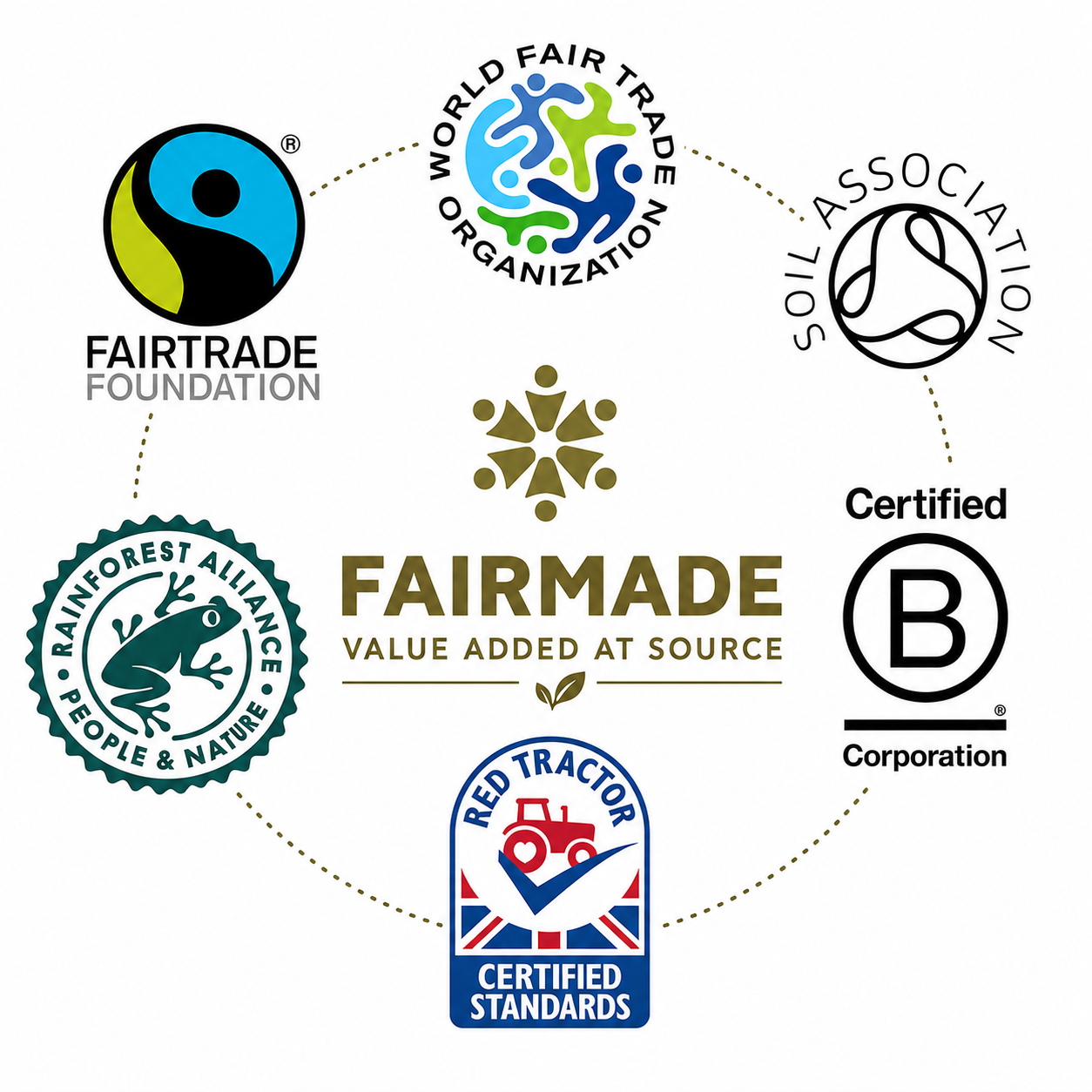

We Are Fair Trade · Reference Note
Ethical Logos: Pros & Cons
A quick, side-by-side look at the most common ethical and assurance marks - weighing what each one actually guarantees.
We have also added the new kid on the block: Fairmade / Value Added at Source, which works on a different axis.
This comparison Is based on ethical rigour: depth of standards, strength of auditing, and real benefit to producers, workers, animals or the environment.
Lens: Ethical rigour & credibility
Higher rigour Moderate / mixed Lower / baseline
Fairtrade (Fairtrade International / FLOCERT)
Product certification · commodity supply chains (coffee, cocoa, bananas, etc.)
Rigour: High
Ethical strengths
- Guarantees a Fairtrade Minimum Price (a price floor) plus a Premium paid on top — the only major scheme here with a hard price guarantee.
- Premium is producer-controlled and earmarked for community and business investment (€222.8m disbursed globally in 2023).
- Independent third-party audits by FLOCERT: field, plant and finance inspections, confidential worker interviews, plus unannounced audits over a three-year cycle.
- Largest independent evidence base — a 122-study evidence map (2021–24) points to higher incomes and greater price stability.
- Strong consumer recognition, reinforcing demand.
Ethical weaknesses
- Farmers often sell only 18–37% of output as Fairtrade; the rest goes at market prices, diluting the benefit.
- Certification, inspection and marketing fees eat into what reaches farmers; premium reaching individual farmers is not closely tracked.
- Minimum price still frequently sits below a living income, especially amid rising input costs.
- Mass-balance scheme allows certified and non-certified ingredients to be mixed; meaning the logo can appear on products containing no Fairtrade ingredients with no additional benefit, therefore, going to farmers.
- Impact evidence is mixed — some studies find little measurable poverty reduction.
- Co-ops carry admin and audit overheads that reduce net gains.
Bottom line: The most robust producer-economics guarantee of the six, with genuine independent auditing — but the benefit is capped by how much product actually sells as certified.
Fair Trade — WFTO (World Fair Trade Organization)
Whole-organisation guarantee · not a product mark
Rigour: High (holistic)
Ethical strengths
- Assesses the entire business against 10 Fair Trade Principles - not a single product or ingredient - so fair trade must be the whole company's mission.
- Designed for marginalised producers that commodity certification doesn't reach (artisans, small craft co-ops).
- Guarantee System combines self-assessment, peer/mutual reviews and external verification for a rounded picture.
- Self-assessment reduces cost of entry and reporting
- Members must be committed to 100% Fair Trade, setting them apart from big brands that certify just one line.
Ethical weaknesses
- It is a membership/guarantee system, not product certification — the logo brands the organisation, which can confuse shoppers.
- Reliance on self-assessment and peer review is less arm's-length than a pure third-party audit.
- No minimum-price mechanism attached to specific goods the way Fairtrade has.
- Lower consumer recognition than the Fairtrade Mark.
Bottom line: The strongest signal that a whole company is mission-driven by fair trade. It is ideal for artisan and craft supply chains but weaker as a shelf-level product guarantee.
Rainforest Alliance
Product certification · environmental + social (coffee, cocoa, tea)
Rigour: Moderate / mixed
Ethical strengths
- Broad 2020 Sustainable Agriculture Standard: deforestation, biodiversity, climate-smart farming, human rights, plus living-wage and living-income modules.
- Risk-based, continuous-improvement model with third-party auditing and supply-chain due-diligence tools.
- Very wide market adoption — easy for large brands to source at scale.
- Strong environmental and anti-deforestation focus.
Ethical weaknesses
- No guaranteed minimum price and only a modest premium (~$70/tonne cocoa vs Fairtrade's ~$200) offering less benefit to producers.
- Mass-balance sourcing allows certified and non-certified ingredients to be mixed; the seal can, therefore, appear on products that offer no benefit to farmers.
- Living wage is a "move towards" requirement — farms can stay certified without ever achieving it.
- Audits criticised as insufficiently rigorous; independent investigations (and lawsuits) have alleged child labour on certified farms.
Bottom line: Strong on environment and scale, but the lightest on guaranteed producer income of the fair-trade-adjacent marks. Mass balance means the seal doesn't guarantee the cocoa, tea or coffee in your product was certified.
Red Tractor
UK farm assurance · food safety, traceability, baseline welfare
Rigour: Baseline
Ethical strengths
- Wide coverage assuring traceability, food safety and legal-standard welfare across mainstream UK farming.
- Confirms British origin using a consistent, checkable baseline making it useful as a provenance signal.
- Whole-chain scope from farm to pack.
Ethical weaknesses
- Standards largely track the legal minimum. This scheme permits practices like tail-docking, zero-grazing of dairy cows and intensive housing.
- Owned and funded by the farming/food industry it certifies — a widely cited conflict of interest.
- Inspections are mostly announced and farmer-paid; unannounced visits are as low as ~0.08%.
- Repeated undercover exposés have documented cruelty on assured farms.
- Not an "ethical premium" label — easily mistaken by shoppers for higher welfare than it guarantees.
Bottom line: A food-safety and traceability baseline rather than an ethical or high-welfare mark — treat it as "legal minimum, verified," not as a fair-trade or premium-welfare equivalent.
B Corp (Certified B Corporation · B Lab)
Whole-company certification · social + environmental performance
Rigour: Moderate (improving)
Ethical strengths
- Assesses the whole business — governance, workers, community, environment, customers — not one product.
- Requires a legal commitment to consider all stakeholders, embedding purpose in company structure.
- Strong brand cachet and a large, values-driven community.
- Standards tightened in 2025 after criticism, moving toward firmer, less gameable requirements.
Ethical weaknesses
- Historically heavy reliance on self-reported data and a points-based model makes the scheme relatively easy to game.
- Certification of Nespresso/Nestlé-owned and other multinationals sparked greenwashing accusations.
- High-profile exits (e.g. Dr. Bronner's) over lenient treatment of large multinationals.
- Says nothing specific about producer prices, animal welfare or organic practice. It's about the company, not the goods.
Bottom line: A credible signal of company-wide intent that's getting stricter, but it's a broad corporate-responsibility mark not a guarantee about any particular product, price or welfare standard.
Soil Association
Organic certification · farming, food, animal welfare (UK)
Rigour: High (organic + welfare)
Ethical strengths
- Standards go beyond baseline organic regulation in key areas. It's among the strictest in the UK.
- Strong animal welfare: natural living conditions, no routine antibiotics, tighter limits than EU organic rules.
- Genuine environmental measures on soil health, biodiversity, restricted inputs etc.
- Independent inspection and well-established consumer trust in the organic mark.
Ethical weaknesses
- Scope is organic/environmental and welfare only. It says nothing about fair prices or trade justice for producers.
- Certification and organic production carry higher costs, reflected in premium retail prices.
- Contested cases (e.g. "organic" salmon) over pollution, chemical treatments and a conversion "loophole" have drawn criticism in the past.
Soil association have since banned the practice of converting conventional stock mid-lifecycle and now require animals to be raised as organic for their entire lives. - Mainly UK-focused; less relevant to Global South supply chains.
Bottom line: One of the more demanding marks on environment and animal welfare but it's an organic standard, not a fair-trade one, so pair it with a trade-justice mark where both matter.
Fairmade / Value Added at Source
Trade model & emerging designation · finished product made in the country of origin
Different axis
Ethical strengths
- Tackles the structural inequity that other schemes largely leave untouched: where value is captured. Manufacturing, processing, printing and packaging margins stay in the source country, not just the ingredient price.
- Significantly larger impact. For Instance. making chocolate at origin can increase financial benefit to producer communities by 200–500% vs exporting raw beans.
- Moves communities beyond farming into skilled manufacturing jobs, building resilience and reducing raw-commodity dependence.
- Value set: living wage, decent work (no child/forced labour), transparency on revenue reaching communities, environmental responsibility, local sourcing.
- Gaining recognition — defined for chocolate by the Fine Chocolate Industry Association; Ethical Consumer's 2024 scoring now factors value-added-at-source in.
- Complements rather than competes with the others. For example, a product can be both Fairtrade and Fairmade.
Ethical weaknesses / caveats
- It is a model and movement, not (yet) an independently audited certification — no third-party auditor, formal published standard, or FLOCERT-style enforcement behind the term.
- Currently self-defined and self-declared by an industry group and by retailers (including We Are Fair Trade's own product designations). Credibility rests on transparency, rather than external verification.
- No price-floor mechanism of its own; it's about location of value capture, not a guaranteed minimum price or premium.
- Low consumer recognition compared with the Fairtrade Mark; the term still needs explaining.
- Says nothing on its own about farm-level welfare or organic practice. Those need a separate mark.
Bottom line: The most ambitious idea of the set on how much benefit reaches the Global South — it fixes the value-capture problem that audited schemes don't address. Its weakness is the mirror image of its strength: as a self-declared model it lacks the independent auditing that gives Fairtrade or Soil Association their assurance. Strongest used alongside an audited mark, with transparent evidence to back the claim.
How to read this
The three fair-trade-family marks (Fairtrade, WFTO, Rainforest Alliance) speak mainly to producer justice and price; Soil Association speaks to organic and welfare; Red Tractor is a baseline food-safety assurance; B Corp is a whole-company responsibility mark. Fairmade sits on a different axis entirely. It's not about how a raw commodity is traded, but where the finished product is made, and therefore how much value stays in the source country. That's its distinctive contribution and also why it isn't really a like-for-like competitor: it answers a question the audited certifications don't. Its trade-off is verification. It is a self-declared model today, where the others carry independent third-party auditing. They are complementary rather than interchangeable, and the strongest ethical claim usually stacks an audited mark with value-added-at-source. "Rigour" ratings reflect standard depth, auditing independence and producer/welfare benefit, and are a judgement call, not an official ranking.
Sources
Fairtrade International — standards & how certification works · Fair trade certification (Wikipedia) · WFTO — Guarantee System · Rainforest Alliance — mass balance · Ethical Consumer — is Rainforest Alliance ethical? · Corporate Accountability Lab — child labour findings · Assured Food Standards / Red Tractor (Wikipedia) · Viva! — Red Tractor overview · Consultancy.uk — B Corp greenwashing scepticism · Dr. Bronner's — on B Corp standard revisions · Soil Association — our standards · The Ferret — organic salmon standards criticism · Fairmade — The New Fair · We Are Fair Trade — What is Fairmade · ConfectioneryNews — Fairmade & value at source
Prepared for We Are Fair Trade · July 2026 · Compiled from public sources. Schemes change over time so please verify current accuracy before using the information in this blog post.
Give a little dignity this Christmas
Add a food bank voucher and we'll turn it into toilet paper for our local food bank.
Thank you. Your £0 voucher will help us support our local food bank.